Brazilian records follow their own rules: CPF and CNPJ check digits, CEP postal codes, state abbreviations, area codes (DDD) and the ninth digit on mobile numbers, accents and abbreviations in names and addresses. dbdireto's data quality services use proprietary technology built for Brazilian language and addressing to deliver a database that is complete, standardized and free of duplicates.
All services are available through API/web service integration or batch processing by file exchange (Excel, CSV or TXT).
On this page: Cleansing · Update and enrichment · Deduplication · Unification · Company lists · Geomarketing data · CRM data
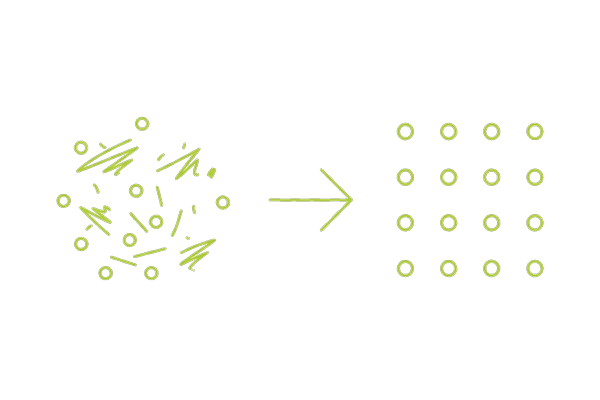
What we deliver
-
01
Standardization
Names, addresses and phone numbers converted to a single format, with a name parser and validation against ANATEL standards.
-
02
Validation
CPF, CNPJ, email and CEP checked against official references: the Correios address directory, check digits and our internal dictionaries.
-
03
Deduplication
Phonetic similarity algorithms find records that are the same and consolidate them automatically.
Data cleansing
Data cleansing (higienização) covers the whole quality cycle: structure analysis, standardization, validation, deduplication and enrichment from official sources. It should come before an ERP or CRM rollout, statistical analyses, BI integrations and direct marketing campaigns.
- Names and company names: removal of invalid characters, case conversion, accent replacement and abbreviation control. A parser splits full names into first, middle and last name.
- Addresses: every component is validated (CEP, street type and name, number, neighborhood, city and state) and cross-checked with the national address directory (DNE) of Correios, the Brazilian postal service. The CEP can be recovered from the street name.
- Phone numbers: area code (DDD) separation, validation against a 10-year dictionary of prefix changes and ANATEL standards, and the ninth-digit update for mobile numbers.
- Emails: structural validation and a cross-check with an internal dictionary of domains. Email providers are not contacted.
- CPF and CNPJ: check-digit validation, with the number split into root, branch and check digits.
- Gender and entity type: gender is assigned from the first name, and individuals are told apart from companies by keywords such as SA, Ltda, Prefeitura or Banco.
Data update and enrichment
Updating revalidates the data you already have; enrichment adds fields you didn't have. Using the CNPJ, CPF or state registration as the key, we query public sources such as Receita Federal and Sintegra and return company name, state registration, CNAE activity codes, estimated revenue, partners, address, phone and email.
Three ways to receive it: batch via FTPS, batch via our self-service web interface (upload a spreadsheet and download the results), or API/web service (SOAP or REST). Results come in Excel, CSV, TXT, XML or JSON.
Deduplication
Our phonetic algorithms generate a code called MatchCode that is the same for different spellings of the same data: "Geraldo Silva", "Geraldo da Silva", "G. Silva" and even "Gerlado Slva", with typos, can share the same MatchCode and be identified as the same person.
You choose the key (name, address, CPF/CNPJ, phone or email) and define the merge or deletion rules with our analysts. You receive either your original database flagged with the MatchCode and duplicate groups, or the consolidated database. Deduplicating before a large campaign can cut 10% to 30% of the mailing cost without losing coverage.
Unification
Unification consolidates records from different sources (CRM, ERP, spreadsheets, e-commerce, partner databases and legacy systems) into a single database: the single customer view. Each source file is loaded into a SQL working database at dbdireto, the final layout is agreed with you, and MatchCode reconciles the same customer across sources.
You receive the unified database in the agreed layout (CSV, Excel, SQL Server or another format), a unique key per entity, the MatchCode for auditing, a merge log, the original databases preserved and a quality report. Typical moments are system migrations, mergers and acquisitions, loyalty programs and BI projects.
Lists of Brazilian companies
For B2B prospecting, direct marketing and market analysis, we deliver lists of Brazilian companies built from automated lookups at Receita Federal and kept up to date. They are also a way to size a market in Brazil: how many companies exist in a segment, city or region, and who operates in the same activity.
- Filters: opening date, estimated number of employees, number of branches, estimated revenue, economic activity (primary and secondary CNAE), legal nature, tax regime (Simples Nacional, Lucro Presumido or Lucro Real) and geography (CEP, city, state or coordinates)
- Data per company: CNPJ, legal and trade name, opening date, registration status, share capital, activity codes, legal nature, full address, phone and email
- Delivery: after you define the segmentation, we estimate how many companies fit the profile and deliver the detailed report within 48 hours, in Excel, CSV or TXT
Geomarketing data
A nationwide database of georeferenced Brazilian companies that covers practically every active CNPJ in the country: latitude and longitude for each establishment (headquarters and branches separately, not just the CEP), with CNAE, size (MEI, ME, EPP or other), share capital, opening date, legal nature, partners and registration status.
The data is updated from official sources (Receita Federal, SPED and NF-e) in monthly cycles and delivered in CSV, Excel or GIS formats (KML, GeoJSON or Shapefile), or consumed via API. It is used by retail chains and franchises, healthcare networks, distributors planning sales routes, banks planning branches and real estate feasibility studies. We are a data provider, not a geomarketing consultancy: the data feeds your own platform, such as QGIS, ArcGIS, Power BI or Tableau, or your partners' tools.
Company data for your CRM
dbdireto doesn't sell a CRM; we provide the B2B database that feeds yours, whether it's HubSpot, Salesforce, RD Station, Pipedrive, Bitrix, Zoho or a proprietary system. There are three ways in:
- Initial segmented load: companies filtered by CNAE, size, region or share capital, to start a sales operation or open a new market
- Enrichment via API: from a CNPJ, we fill in company name, address, size and registration status automatically
- Periodic refresh: monthly or quarterly updates keep your accounts in line with Receita Federal, SPED and NF-e
Before loading new batches, we deduplicate them against your existing database using the CNPJ and the MatchCode, so the same customer doesn't appear three times under different spellings.
Pricing
Cleansing, update and enrichment, deduplication and company lists are priced per record, from BRL 0.20 down to BRL 0.08 as the volume grows. Unification, geomarketing and CRM data projects are quoted according to scope.
Prices in Brazilian reais (BRL); a minimum contract value applies.
Request a quoteFrequently asked questions
What is the difference between data cleansing, standardization and enrichment?
Standardization converts data into a consistent format, such as letter case and abbreviations. Cleansing goes further and validates and corrects wrong data. Enrichment adds information that was not in the original database by querying official sources such as Receita Federal and Sintegra. The three processes complement each other.
What is the difference between deduplication and unification?
Deduplication removes duplicate records within a single database, such as the same customer registered three times in a CRM. Unification consolidates several different databases into a single view, joining for example the ERP record, the CRM history and the e-commerce transactions into one record per customer. Unification usually runs a deduplication as one of its steps.
How does MatchCode work?
MatchCode is a phonetic code generated from a name or another field that is the same for different spellings of the same data. For example, "Geraldo Silva", "Geraldo da Silva" and "G. Silva" generate the same MatchCode, so they can be identified as the same person even when written differently.
Which filters can I use in a list of Brazilian companies?
Opening date, estimated number of employees, number of branches, estimated revenue, primary and secondary economic activity (CNAE), legal nature, tax regime (Simples Nacional, Lucro Presumido or Lucro Real) and geography (CEP, city, state or coordinates).
How quickly do I get a list of Brazilian companies?
After the segmentation is defined, we estimate how many companies match the profile and deliver the detailed report within 48 hours, in Excel, CSV or TXT.
Can these services be integrated via API?
Yes. The data quality services are available via API/web service for integration with your systems, or via batch processing by file exchange (Excel, CSV or TXT).